Hello there, I’m a student at Hertfordshire University and I am looking to develop a technical portfolio which can land me a job plus I’d like to get into the game development pipeline. Previously I was working in Vfx so there is a huge difference. Kindly review my script (Hosted on Github ). And yep hopefully you guys can let me know what I’m doing wrong.
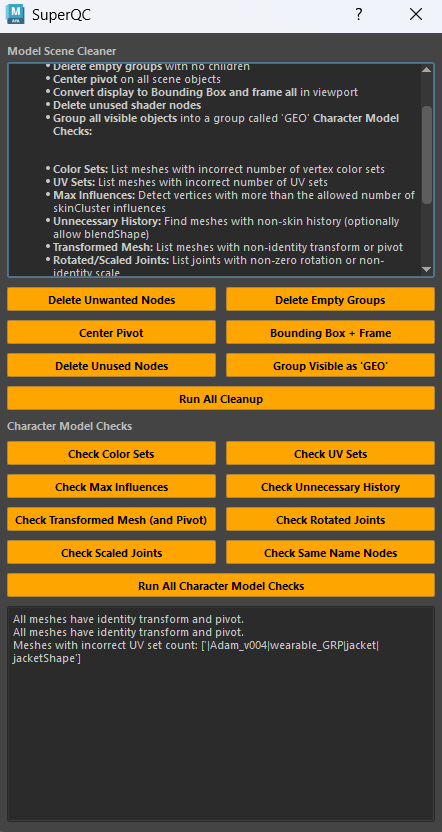
It’s a good start! The UI looks nice and clean. However, there’s a lot of code duplication. Here’s one way to reduce that:
-
Subclass QPushButton. You can include the stylesheet setup in the init, to reduce some redundant code in the dialog init.
-
in the new QPushButton’s init, add some additional arguments: layout, row, column, and columnspan. Also add an argument for the specific cleanup function to run for that button. Now the button can add itself to the layout and also make the connection to its click signal.
-
You can remove the additional layout for the run_all button by adding it to the grid with a columnSpan of 2
class SuperQCButton(QtWidgets.QPushButton):
    def __init__(self, text, layout, row, col, click_fn, colspan=1, parent=None):
        super(SuperQCButton, self).__init__(text, parent=parent)
        orange_style = "background-color: orange; color: black; font-weight: bold;"
        self.click_signal = click_fn

        layout.addWidget(self, row, col, columnSpan=colspan)
        self.btn_check_colorsets.setStyleSheet(orange_style)
        self.clicked.connect(self.click_signal)
- Push the buttons into a list on the dialog object. Then the run_all function can loop through the local list instead of hard-coding the functions twice. We added the click function in the button’s init to a property on the button object, so we can just call that consistent name from the run_all method.
class SuperQC(QtWidgets.QDialog):
    def __init__(self, parent=get_maya_main_window()):
        ...
        self._buttons = []

    def init_ui(self):
        ...
        self._buttons.append(SuperQCButton("New Button 1", button_layout, 0, 0, self.run_button, colspan=1, parent=self))
        self._buttons.append(SuperQCButton("New Button 2", button_layout, 0, 1, self.run_button, colspan=1, parent=self))

        # don't add the run_all to the list or you will infinitely recurse!
        run_all_button = SuperQCButton("Run All", button_layout, 1, 0, self.run_all, colspan=2, parent=self))
        ...

    def run_button(self):
        print('run button!')

    def run_all(self):
        for button in self._buttons:
            button.click_signal()
1 Like
Thank you I’ll get back to you once I am done.
def run_all(self):
    """Run all cleanup actions - HARD-CODED"""
    self.log("Running all cleanup actions...")

    # Every function must be manually called
    self.delete_unwanted_nodes()
    self.delete_empty_groups()
    self.center_pivot()
    self.set_viewport_bounding_box()
    self.delete_unused_nodes()
    self.group_geo()

    self.log("Umbra cleanup finished.")

def run_all_char_checks(self):
    """Run all character checks - HARD-CODED"""
    # Every check must be manually called
    self.check_colorsets()
    self.check_uvsets()
    self.check_max_influences()
    self.check_history()
    self.check_transform()
    self.check_rot_joints()
    self.check_scale_joints()
    self.check_same_name()

    self.log("All character model checks complete.")
Old way, and the improved new way below using list.
self._cleanup_buttons = []
self._check_buttons = []
Full Code:
from PySide2 import QtWidgets, QtCore
from maya import cmds, mel
import maya.OpenMayaUI as omui
from shiboken2 import wrapInstance

def get_maya_main_window():
    main_window_ptr = omui.MQtUtil.mainWindow()
    return wrapInstance(int(main_window_ptr), QtWidgets.QWidget)

# ============================================================================
# CUSTOM BUTTON SUBCLASS
# ============================================================================
# This is a "smart button" that knows how to set itself up automatically.
# By creating a subclass of QPushButton, we inherit all button functionality
# and add our own custom behavior on top of it.
# ============================================================================

class UmbraButton(QtWidgets.QPushButton):
    """
    A custom button that automatically:
    1. Styles itself with orange background
    2. Adds itself to a grid layout at the specified position
    3. Connects its click signal to the provided function

    This eliminates the need to repeat these steps for every button.
    """

    def __init__(self, text, layout, row, col, click_fn, colspan=1, parent=None):
        """
        Args:
            text (str): The text to display on the button
            layout (QGridLayout): The grid layout to add this button to
            row (int): Which row in the grid (0 = first row)
            col (int): Which column in the grid (0 = first column)
            click_fn (function): The function to call when button is clicked
            colspan (int): How many columns the button should span (default: 1)
            parent (QWidget): The parent widget (optional)
        """
        # Call the parent class (QPushButton) constructor first
        # This gives us all the standard button functionality
        super(UmbraButton, self).__init__(text, parent=parent)

        # Define the black/white/grey styling that all our buttons use
        orange_style = "background-color: #2b2b2b; color: white; font-weight: bold; border: 1px solid #555555;"

        # Store the function that should be called when clicked
        # We store it as an attribute so we can access it later
        self.click_function = click_fn

        # Apply the orange style to THIS button (self refers to this button instance)
        self.setStyleSheet(orange_style)

        # Add this button to the grid layout at the specified position
        # columnSpan parameter makes the button stretch across multiple columns
        layout.addWidget(self, row, col, 1, colspan)

        # Connect the button's clicked signal to our function
        # When the button is clicked, it will automatically call click_fn
        self.clicked.connect(self.click_function)

# ============================================================================
# MAIN DIALOG CLASS
# ============================================================================

class Umbra(QtWidgets.QDialog):
    def __init__(self, parent=get_maya_main_window()):
        super(Umbra, self).__init__(parent)
        self.setWindowTitle("Umbra")
        self.setMinimumSize(450, 800)
        self.setWindowFlags(self.windowFlags() ^ QtCore.Qt.WindowContextHelpButtonHint)
        # Set dark color scheme for the dialog
        self.setStyleSheet("background-color: #1e1e1e; color: white;")

        # ====================================================================
        # BUTTON LISTS
        # ====================================================================
        # These lists will store references to our buttons.
        # This allows us to loop through all buttons in the "Run All" functions
        # instead of hard-coding each function call.
        # ====================================================================
        self._cleanup_buttons = []  # Stores Model Scene Cleaner buttons
        self._check_buttons = []    # Stores Character Model Check buttons

        self.init_ui()

    def init_ui(self):
        layout = QtWidgets.QVBoxLayout(self)

        # --- Model Scene Cleaner Section ---
        cleaner_label = QtWidgets.QLabel("<b>Model Scene Cleaner</b>")
        layout.addWidget(cleaner_label)

        # ====================================================================
        # MODEL SCENE CLEANER BUTTONS (Using our custom UmbraButton class)
        # ====================================================================
        # Notice how each button creation is now just ONE line instead of THREE:
        # - No need to manually add to layout
        # - No need to manually set style
        # - No need to manually connect signal
        # The UmbraButton class handles all of that automatically!
        # ====================================================================

        button_layout = QtWidgets.QGridLayout()

        # Each button is created with: (text, layout, row, col, function_to_call)
        # append() adds the button to our list so we can loop through it later
        self._cleanup_buttons.append(
            UmbraButton("Delete Unwanted Nodes", button_layout, 0, 0,
                         self.delete_unwanted_nodes, parent=self)
        )
        self._cleanup_buttons.append(
            UmbraButton("Delete Empty Groups", button_layout, 0, 1,
                         self.delete_empty_groups, parent=self)
        )
        self._cleanup_buttons.append(
            UmbraButton("Center Pivot", button_layout, 1, 0,
                         self.center_pivot, parent=self)
        )
        self._cleanup_buttons.append(
            UmbraButton("Bounding Box + Frame", button_layout, 1, 1,
                         self.set_viewport_bounding_box, parent=self)
        )
        self._cleanup_buttons.append(
            UmbraButton("Delete Unused Nodes", button_layout, 2, 0,
                         self.delete_unused_nodes, parent=self)
        )
        self._cleanup_buttons.append(
            UmbraButton("Group Visible as 'GEO'", button_layout, 2, 1,
                         self.group_geo, parent=self)
        )

        layout.addLayout(button_layout)

        # The "Run All" button spans 2 columns (colspan=2)
        # We DON'T add it to the list to avoid infinite recursion!
        # (If we did, clicking "Run All" would call itself forever)
        UmbraButton("Run All Cleanup", button_layout, 3, 0,
                     self.run_all, colspan=2, parent=self)

        # ====================================================================
        # CHARACTER MODEL CHECKS SECTION
        # ====================================================================
        # Same pattern as above - each button is one line!
        # Compare this to the old code that required:
        # - 1 line to create
        # - 1 line to add to layout
        # - 1 line to set style
        # - 1 line to connect signal
        # That's 4 lines reduced to 1 line per button!
        # ====================================================================

        char_label = QtWidgets.QLabel("<b>Character Model Checks</b>")
        layout.addWidget(char_label)

        char_button_layout = QtWidgets.QGridLayout()

        # Create all check buttons and add them to the _check_buttons list
        self._check_buttons.append(
            UmbraButton("Check Color Sets", char_button_layout, 0, 0,
                         self.check_colorsets, parent=self)
        )
        self._check_buttons.append(
            UmbraButton("Check UV Sets", char_button_layout, 0, 1,
                         self.check_uvsets, parent=self)
        )
        self._check_buttons.append(
            UmbraButton("Check Max Influences", char_button_layout, 1, 0,
                         self.check_max_influences, parent=self)
        )
        self._check_buttons.append(
            UmbraButton("Check Unnecessary History", char_button_layout, 1, 1,
                         self.check_history, parent=self)
        )
        self._check_buttons.append(
            UmbraButton("Check Transformed Mesh (and Pivot)", char_button_layout, 2, 0,
                         self.check_transform, parent=self)
        )
        self._check_buttons.append(
            UmbraButton("Check Rotated Joints", char_button_layout, 2, 1,
                         self.check_rot_joints, parent=self)
        )
        self._check_buttons.append(
            UmbraButton("Check Scaled Joints", char_button_layout, 3, 0,
                         self.check_scale_joints, parent=self)
        )
        self._check_buttons.append(
            UmbraButton("Check Same Name GEO", char_button_layout, 3, 1,
                         self.check_same_name, parent=self)
        )

        layout.addLayout(char_button_layout)

        # "Run All" button spans 2 columns and is NOT added to the list
        UmbraButton("Run All Character Model Checks", char_button_layout, 4, 0,
                     self.run_all_char_checks, colspan=2, parent=self)

        # ====================================================================
        # LOG OUTPUT
        # ====================================================================
        self.log_output = QtWidgets.QTextEdit()
        self.log_output.setReadOnly(True)
        self.log_output.setStyleSheet("background-color: #2b2b2b; color: white; border: 1px solid #555555;")
        layout.addWidget(self.log_output)

        # ====================================================================
        # NOTICE: No more signal connections or styling needed!
        # ====================================================================
        # All those connections and styling are now handled automatically
        # by the UmbraButton class. This eliminates 33+ lines of code!
        # ====================================================================
        # OLD WAY (what we removed):
        #   - 17 lines of .clicked.connect() calls
        #   - 17 lines of .setStyleSheet() calls
        #   - 17 lines of .addWidget() calls
        # NEW WAY:
        #   - All handled in UmbraButton.__init__()
        # ====================================================================

    def log(self, message, color=None):
        if color:
            self.log_output.append(f'<span style="color: {color};">{message}</span>')
        else:
            self.log_output.append(message)
        print(message)

    def delete_unwanted_nodes(self):
        nodes = cmds.ls(type=["unknown", "unknownDag", "unknownTransform"])
        if nodes:
            cmds.delete(nodes)
            self.log(f"Deleted {len(nodes)} unwanted nodes.", color='lime')
        else:
            self.log("No unwanted nodes found.", color='lime')

    def delete_empty_groups(self):
        groups = [grp for grp in cmds.ls(type="transform") if not cmds.listRelatives(grp)]
        if groups:
            cmds.delete(groups)
            self.log(f"Deleted {len(groups)} empty groups.", color='lime')
        else:
            self.log("No empty groups found.", color='lime')

    def center_pivot(self):
        all_objects = cmds.ls(dag=True, long=True)
        for obj in all_objects:
            try:
                cmds.select(obj, r=True)
                mel.eval("CenterPivot;")
            except Exception:
                pass
        self.log("Centered pivot on all objects.", color='lime')

    def set_viewport_bounding_box(self):
        try:
            panels = cmds.getPanel(type="modelPanel")
            for panel in panels:
                cmds.modelEditor(panel, edit=True, displayAppearance="boundingBox")
            mel.eval("FrameAll;")
            self.log("Set all viewports to Bounding Box shading mode and framed viewport.", color='lime')
        except Exception as e:
            self.log(f"Viewport update failed: {e}", color='red')

    def delete_unused_nodes(self):
        try:
            mel.eval('hyperShadePanelMenuCommand("hyperShadePanel1", "deleteUnusedNodes");')
            self.log("Deleted unused shader nodes.", color='lime')
        except Exception as e:
            self.log(f"Failed to delete unused nodes: {e}", color='red')

    def group_geo(self):
        objs = cmds.ls(visible=True, long=True)
        if objs:
            ungrouped_objs = [obj for obj in objs if not cmds.listRelatives(obj, parent=True)]
            if ungrouped_objs:
                cmds.group(ungrouped_objs, name="GEO")
                self.log(f"Grouped {len(ungrouped_objs)} visible, ungrouped objects into 'GEO'.", color='lime')
            else:
                self.log("No ungrouped objects to group.", color='lime')
        else:
            self.log("No visible objects to group.", color='lime')

    def run_all(self):
        """
        Runs all cleanup functions by looping through the _cleanup_buttons list.

        OLD WAY: Hard-code each function call
            self.delete_unwanted_nodes()
            self.delete_empty_groups()
            ... etc ...

        NEW WAY: Loop through buttons and call their stored functions
            for button in self._cleanup_buttons:
                button.click_function()

        BENEFITS:
        - Adding a new button automatically adds it to "Run All"
        - No need to update this function when adding/removing buttons
        - Less code, fewer places to make mistakes
        """
        self.log("Running all cleanup actions...")

        # Loop through each cleanup button and call its associated function
        for button in self._cleanup_buttons:
            # Remember: we stored the function in the button's click_function attribute
            button.click_function()

        self.log("Umbra cleanup finished.")

    # --- Character Model Checks Functions ---
    def check_colorsets(self):
        correct_colorset_count = 1  # Default, can be made user-configurable
        meshes = cmds.ls(type='mesh', long=True)
        error_meshes = []
        for mesh in meshes:
            if not cmds.getAttr(mesh + '.intermediateObject'):
                color_sets = cmds.polyColorSet(mesh, q=True, acs=True)
                if color_sets is not None:
                    if len(color_sets) != correct_colorset_count:
                        error_meshes.append(mesh)
                elif correct_colorset_count != 0:
                    error_meshes.append(mesh)
        if error_meshes:
            cmds.select(error_meshes, r=True)
            self.log(f"Meshes with incorrect color set count: {error_meshes}", color='red')
        else:
            self.log("All meshes have the correct number of color sets.", color='lime')

    def check_uvsets(self):
        correct_uvset_count = 1  # Default, can be made user-configurable
        meshes = cmds.ls(type='mesh', long=True)
        error_meshes = []
        for mesh in meshes:
            if not cmds.getAttr(mesh + '.intermediateObject'):
                uv_sets = cmds.polyUVSet(mesh, q=True, auv=True)
                if uv_sets is not None:
                    if len(uv_sets) != correct_uvset_count:
                        error_meshes.append(mesh)
                elif correct_uvset_count != 0:
                    error_meshes.append(mesh)
        if error_meshes:
            cmds.select(error_meshes, r=True)
            self.log(f"Meshes with incorrect UV set count: {error_meshes}", color='red')
        else:
            self.log("All meshes have the correct number of UV sets.", color='lime')

    def check_max_influences(self):
        max_influences = 4  # Default, can be made user-configurable
        meshes = cmds.ls(type='mesh', long=True)
        error_verts = []
        for mesh in meshes:
            transform = cmds.listRelatives(mesh, parent=True, fullPath=True)
            if not transform:
                continue
            transform = transform[0]
            vtx_list = cmds.ls(f'{transform}.vtx[*]', fl=True)
            sc = None
            for history in cmds.listHistory(transform):
                if cmds.objectType(history) == 'skinCluster':
                    sc = history
                    break
            if sc is not None:
                for vtx in vtx_list:
                    skin_values = cmds.skinPercent(sc, vtx, q=True, v=True)
                    non_zero_values = [v for v in skin_values if v != 0]
                    if len(non_zero_values) > max_influences:
                        error_verts.append(vtx)
        if error_verts:
            cmds.select(error_verts, r=True)
            self.log(f"Vertices with more than {max_influences} influences: {error_verts}", color='red')
        else:
            self.log("No vertices exceed the max influences.", color='lime')

    def check_history(self):
        meshes = cmds.ls(type='mesh', long=True)
        error_meshes = []
        for mesh in meshes:
            transform = cmds.listRelatives(mesh, parent=True, fullPath=True)
            if not transform:
                continue
            transform = transform[0]
            his_list = cmds.listHistory(transform, pdo=True)
            bad_his = []
            if his_list is not None:
                for his in his_list:
                    node_type = cmds.nodeType(his)
                    if node_type in ['skinCluster', 'tweak', 'groupParts', 'groupId', 'shadingEngine']:
                        continue
                    elif node_type == 'blendShape':
                        continue  # Optionally allow blendShape
                    else:
                        bad_his.append(his)
                if len(bad_his) >= 1:
                    error_meshes.append(transform)
        if error_meshes:
            cmds.select(error_meshes, r=True)
            self.log(f"Meshes with unnecessary history: {error_meshes}", color='red')
        else:
            self.log("No unnecessary history found.", color='lime')

    def check_transform(self):
        decimal_places = 3  # Default, can be made user-configurable
        meshes = cmds.ls(type='mesh', long=True)
        error_meshes = []
        for mesh in meshes:
            transform = cmds.listRelatives(mesh, parent=True, fullPath=True)
            if not transform:
                continue
            transform = transform[0]
            attrs = ['tx', 'ty', 'tz', 'rx', 'ry', 'rz', 'sx', 'sy', 'sz',
                     'rotatePivotX', 'rotatePivotY', 'rotatePivotZ',
                     'scalePivotX', 'scalePivotY', 'scalePivotZ']
            values = [cmds.getAttr(f'{transform}.{attr}') for attr in attrs]
            # Check translation/rotation != 0, scale != 1, pivots != 0
            if (round(values[0], decimal_places) != 0 or
                round(values[1], decimal_places) != 0 or
                round(values[2], decimal_places) != 0 or
                round(values[3], decimal_places) != 0 or
                round(values[4], decimal_places) != 0 or
                round(values[5], decimal_places) != 0 or
                round(values[6], decimal_places) != 1 or
                round(values[7], decimal_places) != 1 or
                round(values[8], decimal_places) != 1 or
                round(values[9], decimal_places) != 0 or
                round(values[10], decimal_places) != 0 or
                round(values[11], decimal_places) != 0 or
                round(values[12], decimal_places) != 0 or
                round(values[13], decimal_places) != 0 or
                round(values[14], decimal_places) != 0):
                error_meshes.append(transform)
        if error_meshes:
            cmds.select(error_meshes, r=True)
            self.log(f"Meshes with non-identity transform or pivot: {error_meshes}", color='red')
        else:
            self.log("All meshes have identity transform and pivot.", color='lime')

    def check_rot_joints(self):
        decimal_places = 3  # Default, can be made user-configurable
        joints = cmds.ls(type='joint', long=True)
        error_joints = []
        for joint in joints:
            rx = cmds.getAttr(f'{joint}.rx')
            ry = cmds.getAttr(f'{joint}.ry')
            rz = cmds.getAttr(f'{joint}.rz')
            if (round(rx, decimal_places) != 0 or
                round(ry, decimal_places) != 0 or
                round(rz, decimal_places) != 0):
                error_joints.append(joint)
        if error_joints:
            cmds.select(error_joints, r=True)
            self.log(f"Joints with non-zero rotation: {error_joints}", color='red')
        else:
            self.log("All joints have zero rotation.", color='lime')

    def check_scale_joints(self):
        decimal_places = 3  # Default, can be made user-configurable
        joints = cmds.ls(type='joint', long=True)
        error_joints = []
        for joint in joints:
            sx = cmds.getAttr(f'{joint}.sx')
            sy = cmds.getAttr(f'{joint}.sy')
            sz = cmds.getAttr(f'{joint}.sz')
            if (round(sx, decimal_places) != 1 or
                round(sy, decimal_places) != 1 or
                round(sz, decimal_places) != 1):
                error_joints.append(joint)
        if error_joints:
            cmds.select(error_joints, r=True)
            self.log(f"Joints with non-identity scale: {error_joints}", color='red')
        else:
            self.log("All joints have identity scale.", color='lime')

    def check_same_name(self):
        transforms = cmds.ls(type='transform')
        error_nodes = []
        for node in transforms:
            if '|' in node:
                error_nodes.append(node)
        if error_nodes:
            cmds.select(error_nodes, r=True)
            self.log(f"Nodes with duplicate names: {error_nodes}", color='red')
        else:
            self.log("No duplicate node names found.", color='lime')

    def run_all_char_checks(self):
        """
        Runs all character model checks by looping through the _check_buttons list.

        Same principle as run_all() above - we loop through the buttons
        instead of hard-coding each function call.
        """
        # Loop through each check button and call its associated function
        for button in self._check_buttons:
            button.click_function()

        self.log("All character model checks complete.")

def show_umbra():
    for widget in QtWidgets.QApplication.allWidgets():
        if isinstance(widget, Umbra):
            widget.close()
    win = Umbra()
    win.show()

# Run the tool
show_umbra()
Also I would like to get started on maya-USD and if you could provide any new and updated links that would be nice.