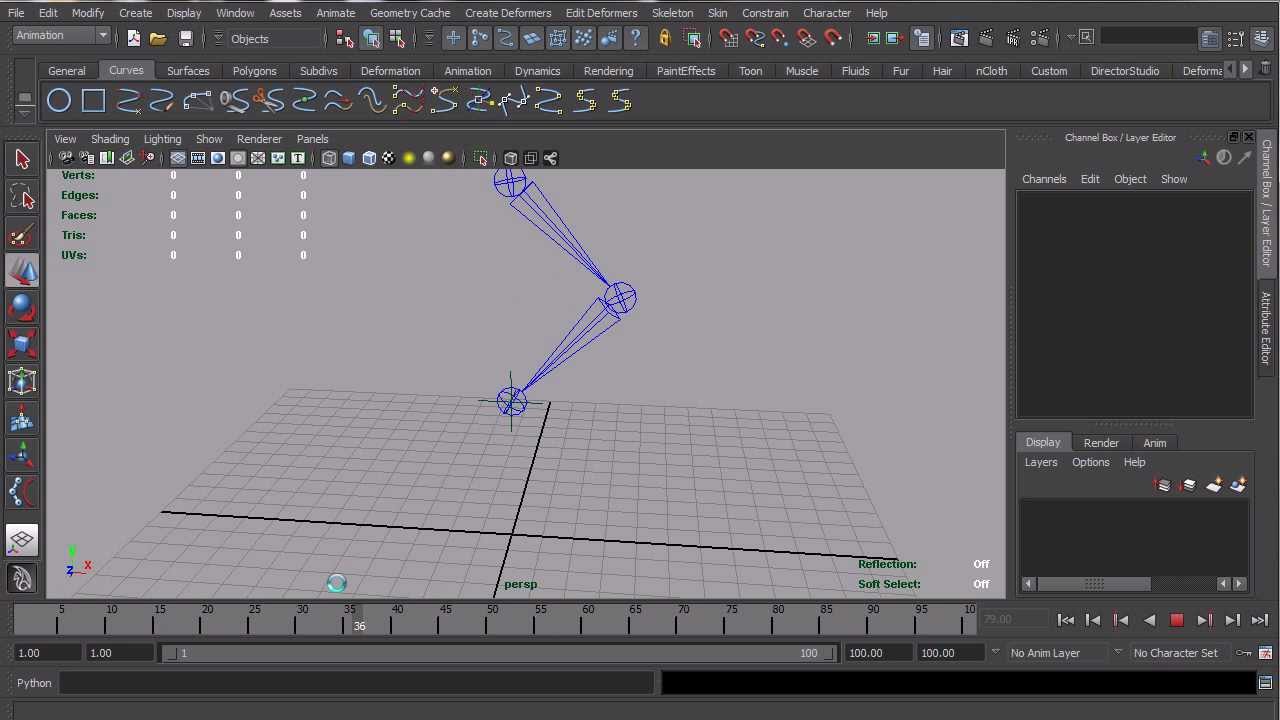
Hey there,
So I’m creating a rig where I want a NoFlip IK chain but I also want to use a Pole Vector with it. Each requirement on it’s own is fairly simple to do, but I can’t get them to work together.
I also can’t find any free rigs with both to dissect so I was hoping someone might be able to suggest a solution?
The closest I’ve gotten is creating the traditional NoFlip leg and then parenting a locator to the IK Handle. Then I created an Aim constraint from the locator to the pole vector and added the rotation of the Locator to the offset.
It works for about 80% of the rotation but it pops to a negative value for the rest of the range.
So, are you saying you want to be able to switch from a no-flip setup to a pole vector set up? Or are you saying you want a no-flip setup but instead of having a knee attribute you want a pole vector control?
I saw a reel recently that had that in it…I have been trying to solve the same issue since and found no definitive answer. The only thing that I have come up with is to create 2 ik chains. One has the no-flip and the other has a pole vector control, but the no-flip drives the pole vector. If you group the pole vector control and then parent constrain that group to the knee joint of the no-flip ik then it follows the knee rotation and then you can still use the ik as an offset of that. Then just use blend color node or parent/orient constraints to have the joints follow one another.
Here is a link to a quick video showing it in action:
But Anzovin’s rigging skills are above my understanding right now to deconstruct.
EDIT: That’s awesome Matt. It works really well for the IK leg. I’m going to try and use it on a stretchy leg with bend bows next and see how things go.
Nice. Did you get it working?
I found that tutorial when I was looking fora solution but I got lost in the dense text.
Matt’s idea worked pretty well. It’s still not 100%(the way I have it setup anyway) but as an animator, it genuinely speeds up animating quite a bit, because I don’t have to worry about knee positions freaking out.
Yes I got it working nicely. I had to read thru the text a few times and look at the scene provided to fully understand it.
I like this one because of how its layered, where you can have the no-flip knee AND the pole vector going at the same time. Might not be necessary, but it allows for it.
Ah I’m glad you got it working. I’d like to give this tutorial another shot sometime though, to see how it compares. It’s odd how little material there is on this because a lot of animators I ask, think it would be quite convenient.
I did manage to get Matt’s method working in a way that allows you to toggle between both/either pole Vector/noFlip.
And of course it works individually of any other rig features like reverse hand/foot and bendy/stretchy limbs.
I love having a modular rig. (Only ever been taught integrated rigging…faster to setup but a pain to maintain/upgrade)
I had managed to solve this some time back by not using the pole vector constraint, but use a locator to indicate the vector direction and feed it’s position directly to IK pole vector. There are multiple benefits to this idea. You can parent the locator such that your pole vector will rotate when you rotate the foot control. Also, you can allow animators to translate the pole vector control and animate it without flipping the IK chain.
I’m not sure if you’ve seen it already as Matthew’s vimeo-page was linked to earlier. But he recently did a video-tutorial on the setup: http://vimeo.com/35070310
EDIT: Oops, didn’t see that Matt’s post was updated with the same link :rolleyes:
I made a no flip knee setup tutorial for digital tutors and the rig is available there as well. teake a look at it let me know if it’s what your looking for. I spoke to Anzovin a while back and it seems we two mad scientist think alike and are using the same method on this one.
?Yeah… so I think there are some interesting things in that stuff Farley, more in the cat rig than the human.
Matt, nice clear example, layering the rigs to make the effect work is always a good solution but one that can get complicated quickly once you add in squash, stretch, blending, matching etc.
Pole Vectors are not that big of a problem and automating them creates more work than less for animators. There are a few simple ways to keep the animation on the PV , have it move out of the way and also include some space switching and you can do a nice twist with the foot rig but animators are going to drive how they use it and they want predictable control not fancy that freaks as soon as you get between poses.
Keep the control in the pv, give the pv some options and let the animators work.
thanks guys for all the awesome replies!
Sorry I didn’t reply earlier, but was bombarded with deadlines and wanted to try everything.
@matt, thanks for the video. I got the noflip + PV working with your original idea, with a suitable toggle + bend and squash, so animators have the choice and scriptjobs take care of making sure nothing snaps.
I also like the solution that was posted in your comments. It would be easier to script perhaps.
@Farley are those from the Motion Flow Rigging? I saw those on DT…but haven’t got a chance to test them. Look really cool though. Is the book you mentioned out yet?
The no pop setup is interesting too. How does the blending work so it gives reliable visual feedback to the animator?
@Brad, I agree that keeping things simple is usually the best solution. Personally i always animate with the PV because it’s a graphic indication. But I’m increasingly finding more animators who prefer a twist control or don’t touch it for some shots at all
The idea was not necessarily to create a studio rig, but more for the individual home animator where preferences vary quite a bit and to offer them reliable choices that they can easily pick and choose between.
Something I personally dislike as an animator is when rigs force me to block my shots a particular way. It’s not a dealbreaker by any means, but it does make things a little aggravating.
You have the option to turn on follow leg rotation and position or even world space. I haven’t tried this with
stretchy legs, but it should still work. This is built with one IK chain and an aim constraint system.
Overall I’ve used Matt’s technique in the past and it’s worked out great!
Thanks Matt! :):