I am trying to understand the “two ways” Maya views a scene. I understand most of it, accept for what the left to right (in the case of the Hypergraph), or top/down (in the case of the Outliner), order of the scenes nodes have to do with it.
For example, in the Outliner (with Display > Scene Order set to “Scene Hierarchy”) I can change the order of objects/Nodes by middle mouse dragging them, this change is also reflected in the Hypergraph window. So it does not seem to be arbitrary organisation.
I thought the Outliner is only being used to edit/visualise one of the “two ways” ways to view a scene, which is the Hierarchy but this does not seem to be the case.
I have read the latest documentation sections for the Outliner, Hypergraph and “Nodes and attributes” but cant figure out what the ordering of Nodes/Objects in the Outliner denotes to. Either they dont mention this in the documentation or I am overlooking it.
I guess what I am trying to determine is, if this top/down ordering is the Outliners way of editing/visualising the Dependency graph (inputs/outputs).
I am learning Maya for a TD career, so that is why I am trying to figure this out.
I do not think the outliner displays rendering order
The Outliner shows a hierarchical list of all objects in the scene
It shows parents and children
with display / sort order / scene hierarchy
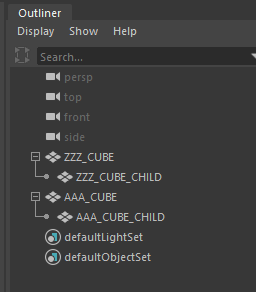
the order of parent root objects is the order in which they are created / added.
Here I created ZZZ_CUBE first, then AAA_Cube :
ZZZ_CUBE sorts on top because it was created first.
cameras sort above that because they were present to begin with.
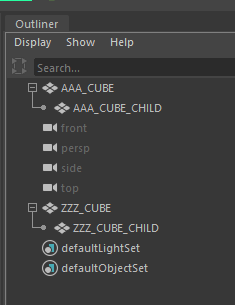
with display / sort order / alphabetical within type
the order of parent root objects is alphabetical
You’ll notice the cameras and cubes get mixed up because their type is all transform
The outliner is not a DAG graph, it is a hierarchy graph. It does not show connections and relationships like the Node Editor or Hypergraph.
I am not sure the left to right order of Hypergraph is intended to convey any information.
It seems to be “creation order” like the outliner in scene hierarchy mode.